Auris icon

Headroom

Auris

Real-time hearing dose meter for audio professionals. Won't make your studio look cooler — but it might keep you working in it longer. Hearing loss is cumulative. So is Auris.

macOS Hearing health NIOSH
7-day free trial · one-time purchase · macOS 14+ · Release notes Have questions? Read the FAQ →
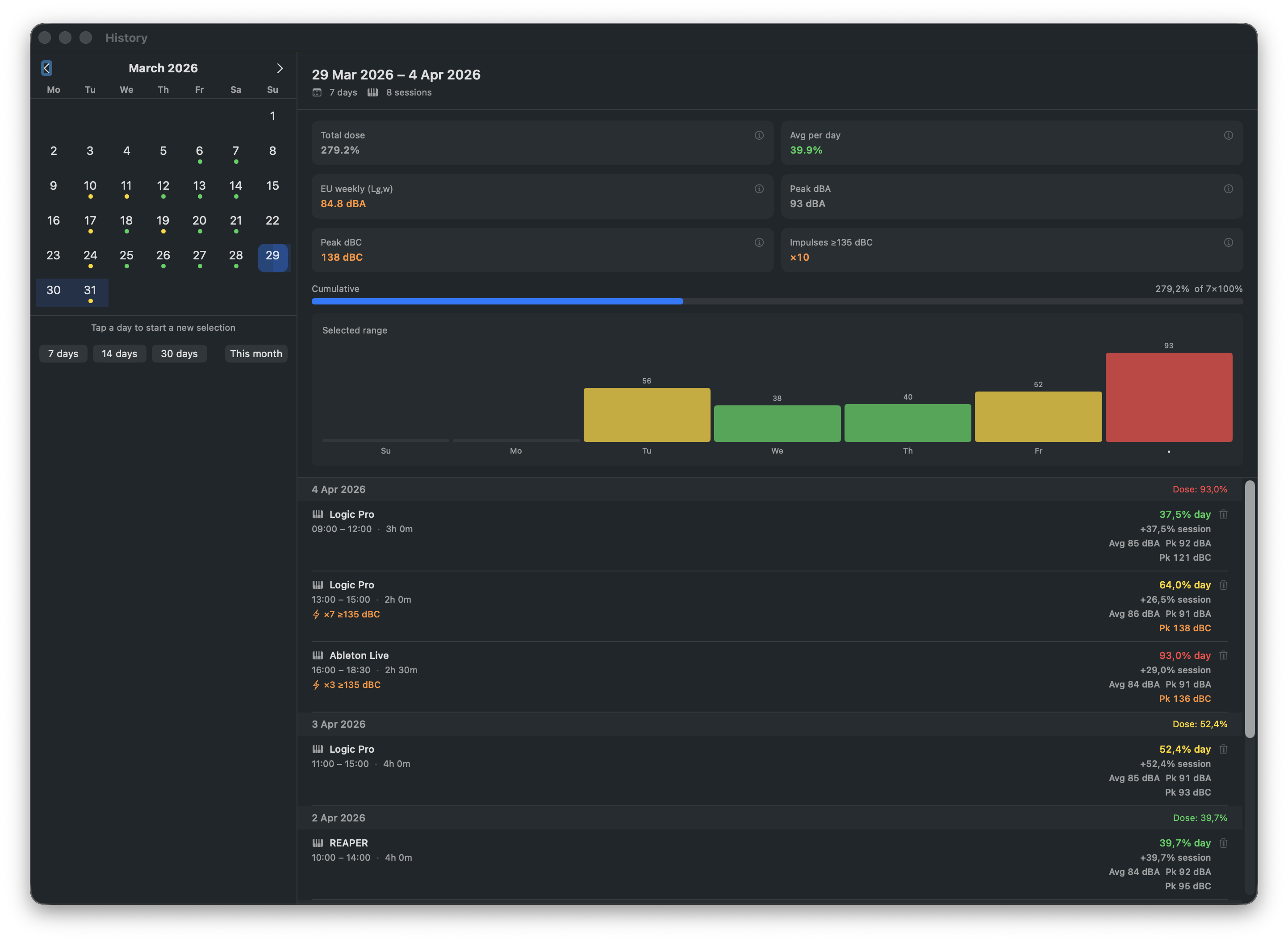
Auris session history window showing past recording sessions with dose and peak levels
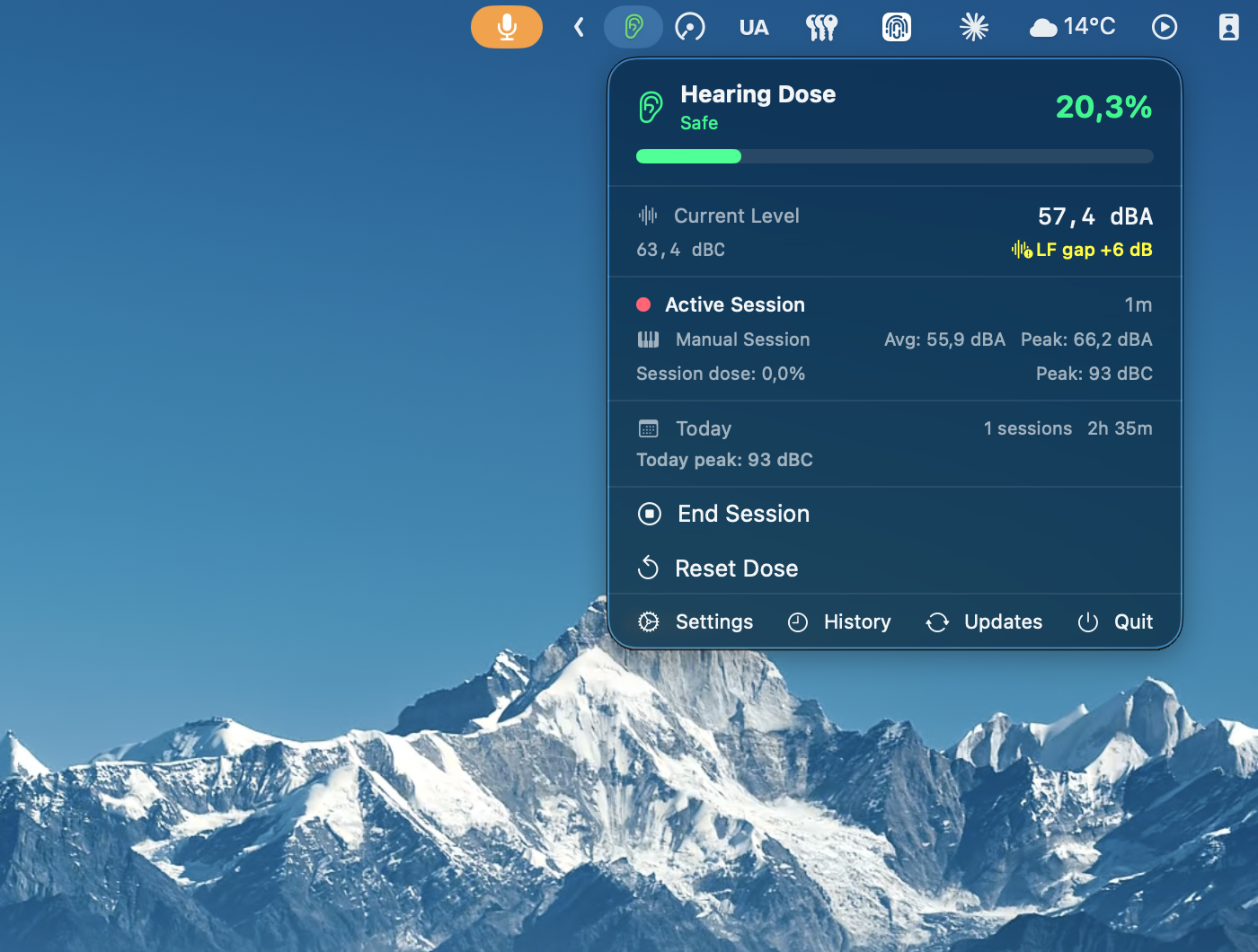
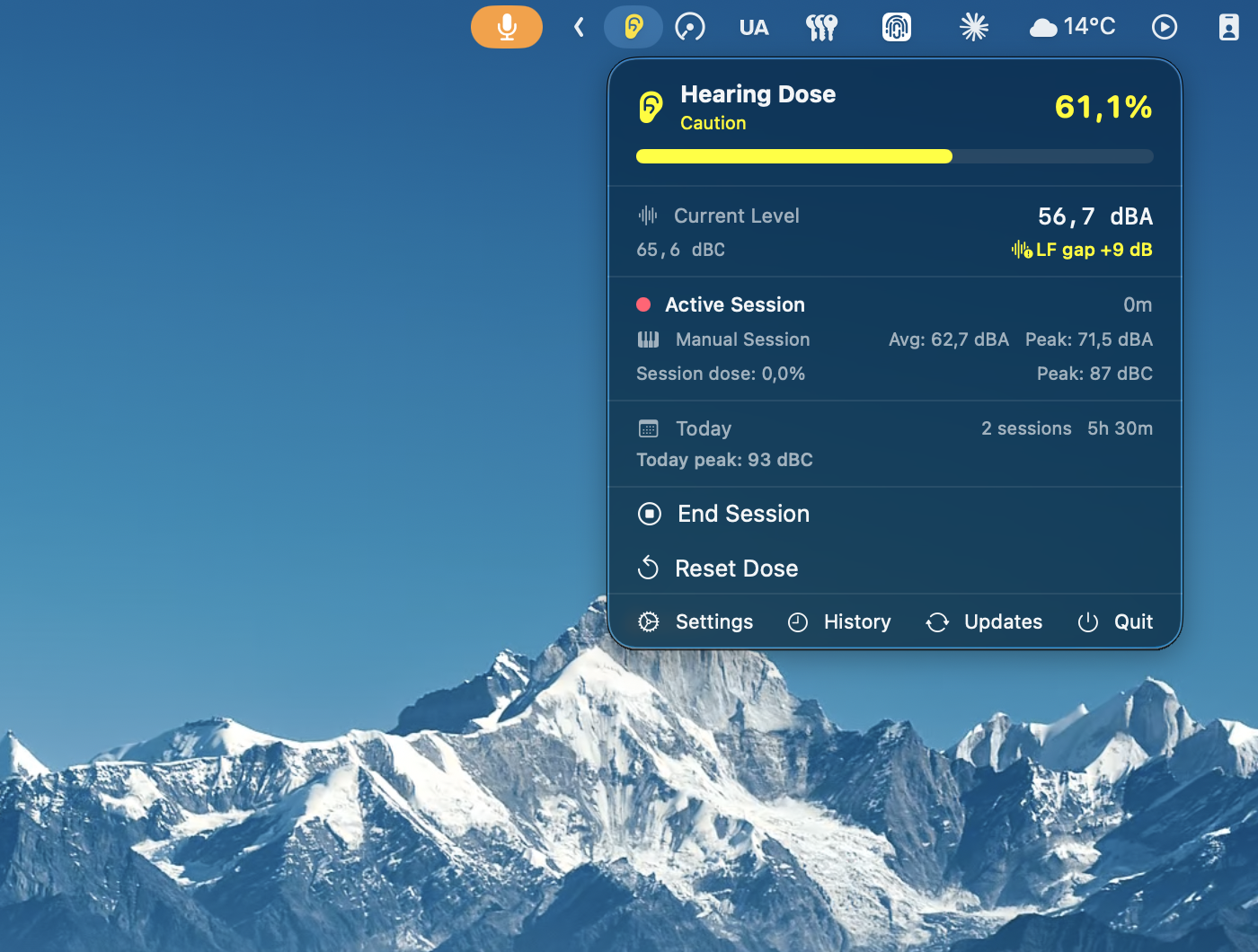
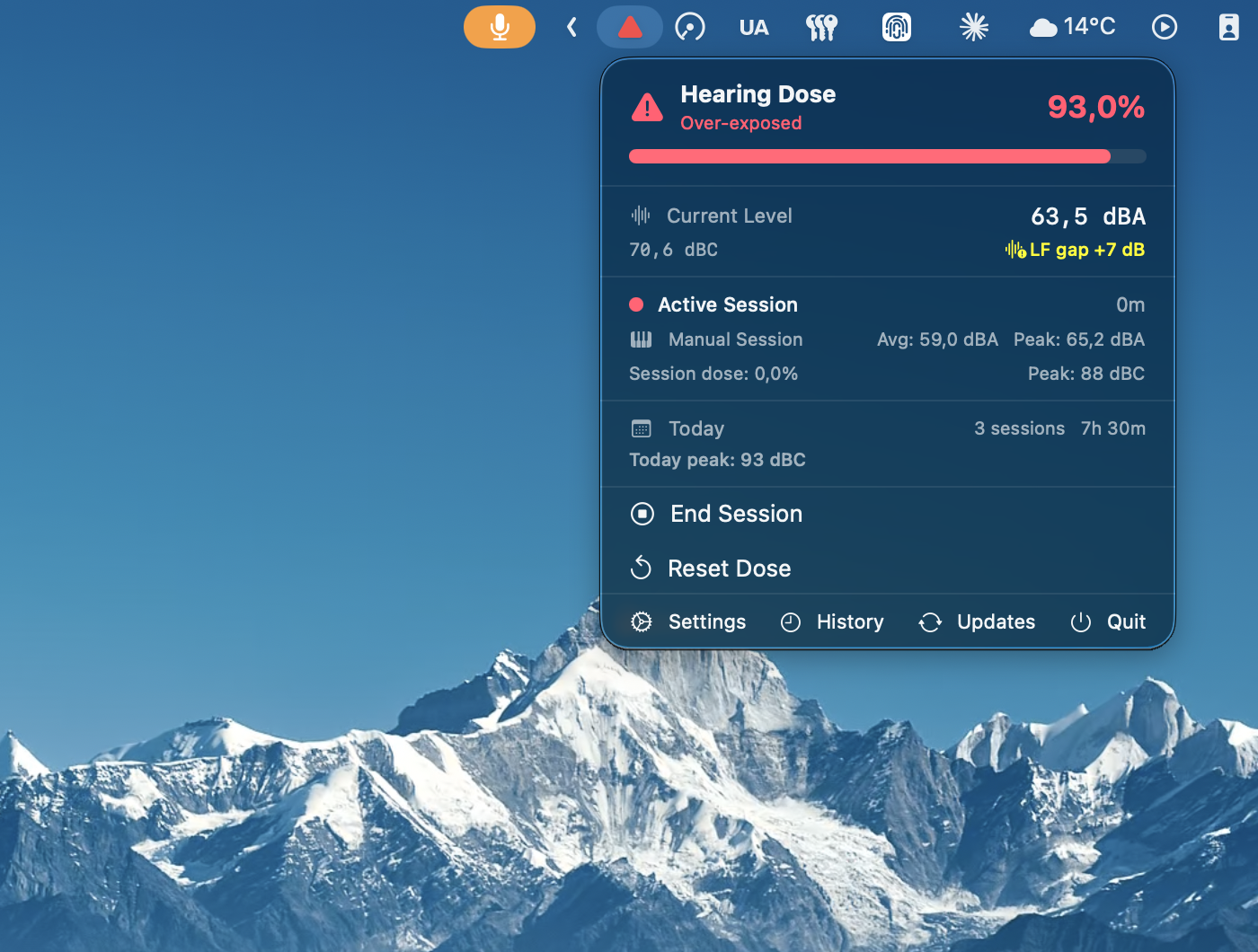
Auris menu bar popover — Safe dose level (green) Auris menu bar popover — Caution dose level (yellow) Auris menu bar popover — Danger dose level (red)

The most common occupational hazard in audio has no pain signal.

Studies consistently place noise-induced hearing loss among the top health risks for audio professionals — and not just live engineers or touring musicians. Long studio sessions at moderate levels accumulate exactly the same way loud ones do, just more quietly. The ear doesn't distinguish between one very loud hour and eight moderately loud ones. The damage arithmetic is the same.

That's what makes it so easy to ignore. There's no warning before the threshold shifts. By the time something feels off — the top end sounds different, mixing decisions feel harder, a tone that wasn't there before keeps you awake at night — the damage is already permanent. Most professionals know this abstractly. Almost none have ever actually measured their daily exposure.

Auris doesn't add friction to your workflow. It sits in the menu bar, measures while you work, and gives you one number that matters: how much of today's limit you've used. Over weeks and months, patterns emerge — and that's when it actually changes how you work.


Hearing dose Accumulates your daily exposure using the NIOSH formula. Four colour-coded states — Safe, Caution, Warning, Danger — update in the menu bar icon in real time. Resets at midnight. Persists across restarts.
Real-time SPL Continuous A-weighted level at 10 Hz, exponentially smoothed for a stable, readable display. Calibratable to your measurement mic for real-world accuracy.
Leq & Ln stats Rolling energy-average level (Leq) over 1-, 10-, and 30-minute windows shows how loud you have actually been — not just right now. L10, L50, and L90 percentiles reveal the character of a session: L10 captures your loud peaks, L50 your typical working level, L90 the background noise floor. All computed live in the menu bar.
Peak monitoring C-weighted peak impulse tracking per EU Directive 2003/10/EC. Notifies you when levels cross the 135, 137, or 140 dBC action values. Per-session and daily peak counts recorded.
Session tracking Auto-detects when you open a DAW and starts a session. 15 DAWs supported out of the box — Luna, Logic, Pro Tools, Ableton, REAPER, and more. Manual start and end also available.
Session history Full 30-day history with per-session dose contribution, average and peak SPL, and peak impulse counts. Seven-day bar chart shows your weekly EU L_EX,w exposure level at a glance.
History window Dedicated calendar window for exploring any date range in your 30-day archive. Select a range on the calendar to see cumulative dose, daily average, EU weekly level (L_EX,w), peak dBA, peak dBC, and impulse counts — all in one view. Each stat includes an explanation popover with thresholds and regulatory context.
Instantaneous peaks Tracks A-weighted instantaneous peaks above 115 dBA — the EU Directive 2003/10/EC ceiling for any single moment of exposure. Counts per session, separate from the C-weighted impulse limits.
Conservative mode Optional setting that uses max(dBA, dBC) for dose accumulation. Designed for bass-heavy work — sub-mixing, kick drum tracking, live sound — where A-weighting alone may underreport physical energy. No formal standard; a maximum-protection option you can enable in Settings.
Input channel selection Pick any individual input channel from your audio interface — not just the default stereo pair. Useful for measuring via a talkback mic, a dedicated measurement input, or any other channel on multi-channel interfaces like the Apollo Twin X. Channel names are read directly from the driver.
Non-invasive Lives in the menu bar with no Dock icon. Measures passively via any CoreAudio input device — a built-in mic, a measurement mic, or any interface input channel. Nothing touches your signal chain.
Auto-updates Stays current automatically. You'll be notified in the menu when a new version is available.
Launch at login Optionally start with macOS so dose tracking begins as soon as your session does.
macOS Sonoma 14.0 or later
Hardware Any audio interface or built-in input with a measurement microphone
Permission Microphone access (audio is processed locally, never transmitted)

Auris reads audio from a microphone positioned at your listening position and converts it to A-weighted SPL using a proper IEC 61672-1 filter — the same standard used in professional sound level meters. It samples 10 times per second and accumulates your hearing dose according to the NIOSH Recommended Exposure Limit formula. The key relationship: at 85 dBA you have 8 hours; every 3 dB increase halves that time.

LevelSafe duration
85 dBA8 hoursNIOSH criterion
88 dBA4 hours
91 dBA2 hours
94 dBA1 hour
97 dBA30 minutes
100 dBA15 minutes

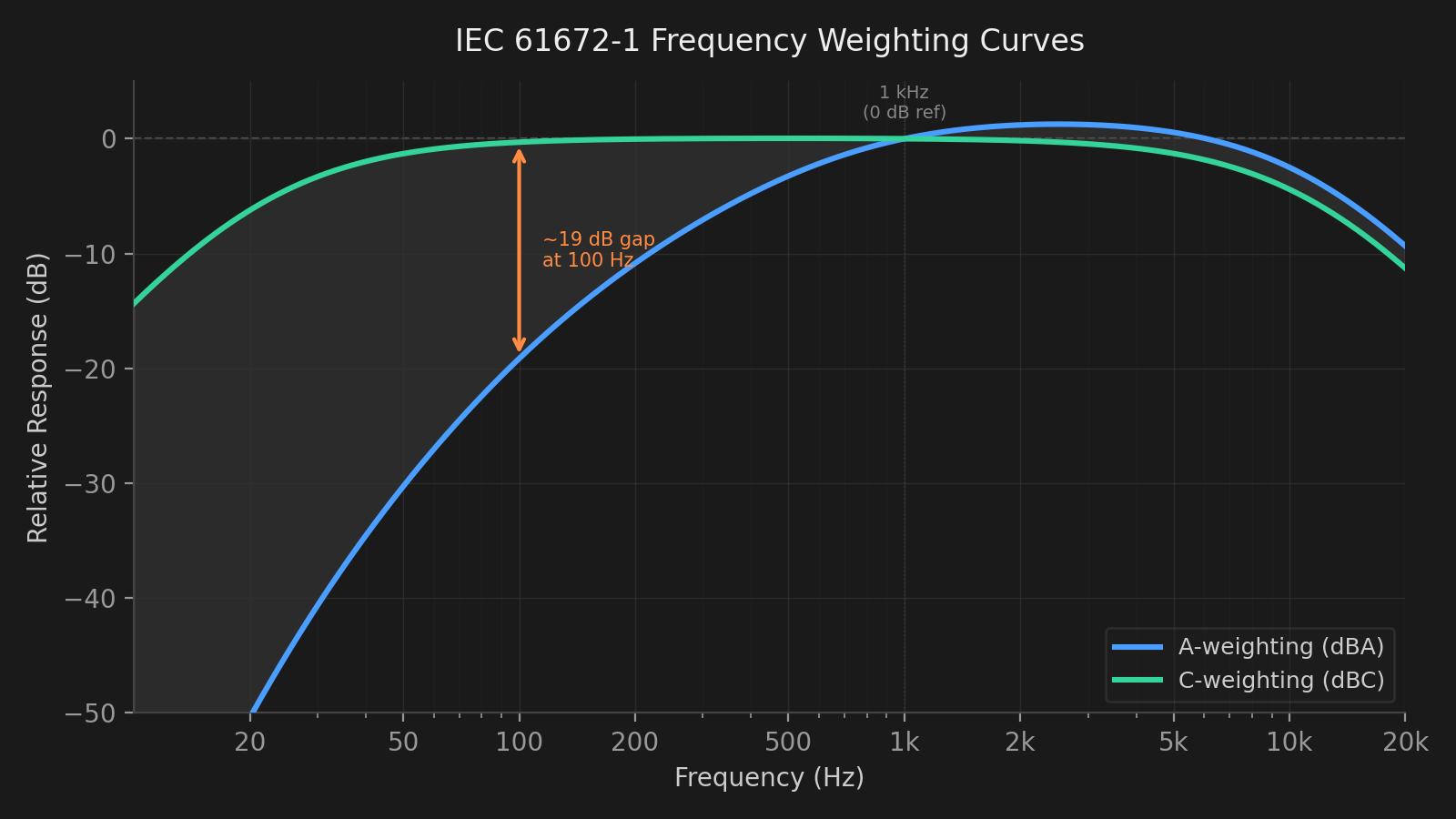
A parallel C-weighted path runs simultaneously for peak impulse monitoring. Unlike A-weighting, C-weighting is nearly flat from 31.5 Hz to 8 kHz — it accurately captures the energy of transient events such as drum hits and loud clicks that can cause immediate cochlear damage regardless of cumulative dose. EU Directive 2003/10/EC specifically mandates C-weighted peak measurement for exactly this reason.

IEC 61672-1 A-weighting and C-weighting frequency response curves showing how A-weighting attenuates low frequencies while C-weighting remains nearly flat

IEC 61672-1 A-weighting vs C-weighting — A-weighting de-emphasises bass, where C-weighting stays flat. The gap between the two readings indicates how much low-frequency energy A-weighting is missing.

All data stays on your Mac. No telemetry, no cloud sync, no servers. More answers in the FAQ →

NIOSH REL 85 dBA reference, 3 dB exchange rate, 80 dBA accumulation threshold — the most protective mainstream occupational noise standard.
IEC 61672-1 International standard for sound level meter frequency weighting — A-weighting (4 biquad IIR sections) and C-weighting (2 biquad IIR sections), both normalised at 1 kHz.
EU 2003/10/EC EU Directive on occupational noise. Defines the 135 / 137 / 140 dBC C-weighted peak action levels and the 115 dBA A-weighted instantaneous ceiling.
ISO 9612 Framework for the weekly noise exposure level (L_EX,w) shown in the session history chart, compared against the 85 dBA weekly criterion.